Showing posts with label religion and scholarship. Show all posts

Archive Envy Redux

Paul Harvey


Over at Religion in the American West, James Bennett writes of archive envy as he bides his summer time stay-at-home-dad-ing and looks forward to future archival research ventures in his new field of religion in the West. Bennett's memories and query recall a thread here which went several rounds last year, and which we'll invite further reflections from anyone interested: Know Your Archives, the last entry of which was quite recently, Know Your [Digital] Archives.

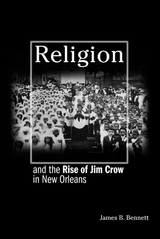
Bennett's post tells of past experiences with at Josephite Fathers archive in Maryland, where he researched for his book Religion and the Rise of Jim Crow in New Orleans, and concludes with this query:

For me, one of the most exciting parts of embarking on a new project is anticipating the new places I’ll do my research. What treasure troves of religion in the American West have you come across?

He invites posts there on experiences researching in archives on Religion in the West, especially the scruffier or off-the-beaten-path places where much of our favorite material and many of our most memorable experiences may have been found. You research road warriors, feel free to add to our Know Your Archives series with a post here or at Religion in the American West.

Finishing the Columbia Guide to Religion in American History (I'll Drink to That!)

Paul Harvey

While some of you reprobates were out testing the new micro-beer selections on the 4th of July, some of us were putting our long personal nightmare (a book manuscript) finally to post and ready to be shipped out for its deployment -- at long last! (I tested out a new bottle of Old Raj gin, the best bottle of alcohol God ever invented, at the end of all this, so I'll have to join the reprobate category).

Our contributor John Fea was finishing up his book Was America Founded as a Christian Nation: A Historical Introduction; and yes, John, finishing is a good feeling. Click on the link for a preview of the book and table of contents. Sounds like the publisher is going to get it out pretty promptly -- Feb. 2011.

On the home front, Randall, Ed Blum, and myself have been working on The Columbia Guide to Religion in American History for the last few years, and some of that has been, in the words of gospel great Thomas Dorsey, through the storm and through the night. I thought we'd be done with this a couple of years ago, but, you know, stuff happens. Anyway, the weekend was spent finishing up most of the last few details on the ms and ready to ship out pretty soon. Here's a preview below -- don't start camping out at the bookstore just yet, as it will be a good while before it gets from final manuscript to actual book, but several of our blog contributors are involved in this project, and others of you have asked me about it from time to time, so here's what it's going to look like once the priceless gem is in your hands (or, more likely, on the library reference shelf, as these Columbia Guide books can get a little expensive!).

As you can see, we've got a nice list of contributors who have written excellent essays on time periods, movements, traditions, and themes in American religious history. The volume also has an extensive A - Z glossary of American religious history and a bibliography which includes books, articles, CDs, DVDs, films, and online resources.

Like I said the last time I did an edited book -- not going to do that again!

Here's a preview for you.

Columbia Guide to Religion in American History
Edited by Paul Harvey and Edward J. Blum
Bibliographic Editor Randall Stephens

Table of Contents

Preface 1-8
Paul Harvey and Edward J. Blum

Introduction 9 - 80
Paul Harvey and Edward J. Blum

Colonial Encounters r 81 - 107
Linford Fisher

Native American Religions 108 - 135
Suzanne Crawford

Civil Religion and National Identity 136 - 156
Andrew Manis

Theology 157 - 179
Mark Noll

Evangelicals in American History 180- 198
Douglas Sweeney

Religion and Politics 199 - 222
Jason Bivins

Religion and the Law 223 - 24
Frank Ravitch

Religion, War, and Peace 245 - 271
Ira Chernus

Religion, Gender, and Sexuality 272 - 297
Anthony Michael Petro

Religion, Race, and African American Life 298 - 328
Edward J. Blum

Religion, Ethnicity, and the Immigrant Experience 329-350
Roberto Trevino

Asian American Religion 351 - 365
Timothy Tseng

Alternative Religious Movements 366 - 385
Stephen Stein

Religion and the Environment 386 – 403
Lynn Ross-Bryant

Religion and Popular Culture 404 – 417
Philip Goff

Conservatism and Fundamentalism 418 - 433
Margaret Bendroth

Catholicism in America 434 - 454
Leslie Woodcock Tentler

American Judaism 455 - 472
Alan Levenson

The Church of Jesus Christ of Latter-Day Saints 473-489
D. Michael Quinn

Islam in America 490 - 509
Jane Smith

A-Z Glossary 510 - 572

Major Surveys, Textbooks, and Reference Guides 573 - 576

Bibliographies by Chapter Titles 577 - 634

Filmography 635 - 641

Discography 642 - 649

Electronic Resources 650 - 658

New Metaphysicals: Online Symposium


Paul Harvey

Every time I post about Glenn Beck or some other late-breaking news from the idiocracy, I feel the need to take a shower by pointing you to something that is actually worthy of your time and energy. So here's the latest in that series of mea culpa posts.

As many of you may know, Courtney Bender's hot-off-the-press book The New Metaphysicals: Spirituality and the American Religious Imagination has been getting a lot of attention. Here's a brief summary from the book's website:

American spirituality—with its focus on individual meaning, experience, and exploration—is usually thought to be a product of the postmodern era. But, as The New Metaphysicals makes clear, contemporary American spirituality has historic roots in the nineteenth century and a great deal in common with traditional religious movements. To explore this world, Courtney Bender combines research into the history of the movement with fieldwork in Cambridge, Massachusetts—a key site of alternative religious inquiry from Emerson and William James to today. Through her ethnographic analysis, Bender discovers that a focus on the new, on progress, and on the way spiritual beliefs intersect with science obscures the historical roots of spirituality from its practitioners and those who study it alike—and shape an enduring set of modern religious possibilities in the process.

Immanent Frame is hosting a sort of online symposium on the work; click here for it. Nathan Schneider interviews the author here. Here's one particularly interesting Q and A from the interview, relevant to our historical discussions here:

NS: How do you do scholarship—and, in so doing, take account of history—about a community that denies its own historicity? I was struck by your claim that “the puzzle of spirituality in America cannot be solved by locating it in a history it refuses.”

CB: It is important to talk about and investigate the various historical links and pasts of contemporary spirituality. History is extremely important, and its elision is an ongoing problem with so much of the popular discourse about spirituality, which tends to suggest that it is a condition rather than a tradition. Sociologists and scholars of American religion need to have a better understanding of the complex religious and cultural pasts that form our present. There are lots more things to be written on these subjects, and while I was writing this book I was able to draw on a number of exceptional new volumes that focus on aspects of these ungainly histories. I’m thinking of work by Christopher White, Leigh Schmidt, Catherine Albanese, Molly McGarry, Alex Owen, Ann Taves, John Lardas Modern, and the list goes on.

But what is puzzling about spirituality is that, even as the number of monographs on the topic grows, these histories don’t seem to resonate with contemporary people who call themselves spiritual, or with most scholars who look at its present manifestations. One reason for this is that the living practices of spirituality allow people to cultivate ways of being in time that are future-focused, or that situate practitioners in perennial time. All religious practices place people in time and in space. In this case, the spiritual practices that I trace do interesting things to the kind of narrative history that most historians write, so paying attention to these practices, and chronicling how they unravel and decouple from most recognizable historical narratives, is just as important. That’s what I have tried to do.

For you Robert Orsi fans, here is his typically engaged and challenging response to the book.

Rereading Creation: Teaching About The Bible, Science, and the Ecology of Wonder

Rereading Creation


Everett Hamner

A good deal of my work has to do with questions of origins. I teach a liberal arts and sciences gateway course on evolution; I am writing a book about how science and religion have interacted in the last century’s fiction. But as a scholar of contemporary American fiction, one course I didn’t imagine teaching was Literature of the Bible. The first time I offered it resulted from a schedule fluke, but it impacted the students so deeply that this fall I’ll be teaching it for the third time. This canon still matters a great deal to students who self-identify both as religious and irreligious.

A key element of the course’s popularity, I think, is that it takes on modern controversies about the Bible and Christianity very directly. We discuss feminism, homosexuality, immigration, terrorism, stem cell research, and other topics alongside the biblical texts most frequently cited when Americans make normative claims. Using documentary films like Craig Detweiler and John Marks’s courageous Purple State of Mind and Daniel Karslake’s poignant For the Bible Tells Me So, I pursue an atmosphere in which students can rethink many of their foundational assumptions in relative safety. In our dominantly white, homogeneous, lower-to-middle-class, Midwestern context, the complicated wisdom that emerges can be life-altering.

I thought about this course while reading a new book Paul Harvey sent along recently by Columbia Theological Seminary Professor of Old Testament William P. Brown. I haven’t read a lot of biblical criticism since my own seminary days, but The Seven Pillars of Creation: The Bible, Science, and the Ecology of Wonder (Oxford, 2010) is a refreshing reminder of what such studies can provide. The book isn’t perfect—there are moments when its alliances of biblical and scientific metaphors feel forced—but it effectively opens what remains a crucial discussion of genre. In approaching intersections of eschatology and cosmology, of predestination and physics, it provides a thoughtful inspection of our hermeneutical lenses.

In past versions of Literature of the Bible, the primary text I have used to get at questions of genre and interpretation is Marcus J. Borg’s Reading the Bible Again for the First Time: Taking the Bible Seriously but Not Literally (HarperSanFrancisco,2001). Borg recommends that Bible readers adopt a posture of “postcritical naivete,” whereby one “hear[s] the biblical stories once again as true stories, even as one knows that they may not be factually true and that their truth does not depend upon their factuality.” One of his best elucidations of this attitude builds on the way many Native American storytellers begin their performances: “Now I don’t know if it happened this way or not, but I know this story is true” (50). Like such narrators, Borg demonstrates that story-truth extends beyond factual evidence, that wisdom exceeds empiricism without countermanding it.

Why is this realization so important, yet so elusive? In my experience with Literature of the Bible, almost every student openly or secretly expects in week one that a choice must be made: either embrace the world of religious tradition and personal righteousness or adopt the route of scientific abstraction and intellectual integrity. And beneath their politically-correct facades, many of the students can only characterize opposing convictions with inflammatory terms. But a realization that consistently helps both groups is that religion is not just Christianity, and apparent tensions between the natural and the supernatural extend well beyond this tradition’s purview.

Consider the scientism critiqued in this paragraph from Leslie Marmon Silko’s Ceremony, I invite them:

The spider came out first. She drank from the edge of the pool, careful to keep the delicate eggs sacs on her abdomen out of the water. She retraced her path, leaving faint crisscrossing patterns in the fine yellow sand. He remembered stories about her. She waited in certain locations for people to come to her for help. She alone had known how to outsmart the malicious mountain Ka’t’sina who imprisoned the rain clouds in the northwest room of his magical house. Spider Woman had told Sun Man how to win the storm clouds back from the Gambler so they would be free again to bring rain and snow to the people. He knew what white people thought about the stories. In school the science teacher had explained what superstition was, and then held the science textbook up for the class to see the true source of explanations. He had studied those books, and he had no reasons to believe the stories any more. The science books explained the causes and effects. But old Grandma always used to say, ‘Back in time immemorial, things were different, the animals could talk to human beings and many magical things still happened.’ He never lost the feeling he had in his chest when she spoke those words, as she did each time she told them stories; and he still felt it was true, despite all they had taught him in school—that long long ago things had been different, and human beings could understand what the animals said, and once the Gambler had trapped the storm clouds on his mountaintop. (87, emphasis in original)

This passage shares a great deal with the mindset Brown’s book encourages: an openness to the possibility of meaning beyond factuality, of wonder beyond mastery, whether the facts to be mastered spring from religious or scientific sources. As the introduction to The Seven Pillars proposes, the book is “a tour of the biblical contours of creation conducted in conversation with science” (5), an expedition that looks beyond the obvious passages in Genesis to equally significant ones in Job, Psalms, Proverbs, Ecclesiastes, and Second Isaiah. While Brown may too easily equate “biblical” with “Christian,” his book models a wonder that usefully contests both religious and scientific absolutism. In this he stretches toward the same goal I pursue for my students: a sense that profound meaning has not disappeared with secularization, that not just “long long ago” but even now, there is great reason for awe. In fact this response remains the source of our best science, a point also made by a recent article in The Chronicle of Higher Education.

I think biblical criticism like Brown’s may prove essential if our culture is to move beyond simplistic arguments about evolution, stem cell research, and genomics. So much of the resistance to biological knowledge and medical intervention is bound up with fear that God is being dishonored, and many Americans need to see either-or thinking about these issues give way to more complex both-and possibilities. By reading Genesis beside preexisting creation narratives like Mesopotamia’s Enuma elish, Brown’s book pulls readers toward active interpretations of their scriptures, much like those of other literature. In the process, he provides fresh images with clear implications for contemporary debates.

Two quick concluding examples: I like the way Brown wittily argues that instead of defining women in terms of men, “in Genesis 2, the separation of flesh makes possible gendered differentiation and, in turn, sexual union. Call it splitting the ‘adam. Through the creation of the woman, the groundling has become a man” (83). In other words, we Earth creatures only find gender identity in relationship; there is no “male” without “female.” Similarly—and unlike too many biblical commentaries—his book recognizes that the natural world of the Pentateuch is “red in tooth and claw” long before human beings appear on the scene, and that in representing “the quintessential ‘alpha male,’” Genesis is hardly attempting to refute concepts of biological evolution that would not emerge for thousands of years. I’ll be referring to Brown in my next version of Literature of the Bible for that reason alone: whether self-identifying as Jewish, Christian, Muslim, Buddhist, atheist, agnostic, or otherwise, my students need every opportunity to grasp that neither the Bible nor any other great wisdom literature is the enemy of scientific discovery.
David Brainerd, God, and the Founders: Choice Reviews

Paul Harvey

Someone pointed me to this book some time ago, but I've never had a chance to take a look at it. Some of you here will be interested, however, so I'm posting the short Choice review below of Vincent Phillip Muñoz, God and the Founders.

Muñoz, Vincent Phillip. God and the founders: Madison, Washington, and Jefferson. Cambridge, 2009. 242p index; ISBN 9780521515153, $85.00; ISBN 9780521735797 pbk, $24.99. Reviewed in 2010jul CHOICE.
Muñoz (Notre Dame) argues that Supreme Court decisions on religion that have cited the Founding Fathers have ignored the complexity of their views. First, he carefully analyzes the writings and political actions on religion of Madison, Washington, and Jefferson, chosen because of their important roles in establishing and defending religious liberty and separation of church and state. Madison favored nonrecognition of religion by the state, Washington advocated supporting religion insofar as it served to inculcate personal morality and civic virtue, and Jefferson sought freedom of opinion but also wanted to weaken the clergy's power and to foster a rational religion undermining orthodox Christianity. Muñoz then uses the Founders' positions to analyze post-1940 Court rulings on establishment and free-exercise cases, providing a chart to illustrate how individual justices voted. Finally, he shows the weaknesses in the Founders' perspectives and in recent jurisprudence and offers as a doctrine with many advantages a modified Madisonian "No legal privileges, no legal penalties." This is an important book; it is well researched and intelligently argued and has important public policy implications. This reviewer's two reservations are that Virginians do not represent all the Founding Fathers, and "profundity" as a test may not represent the politics of religious liberty. Summing Up: Highly recommended. Especially law schools/theological seminaries; upper-level undergraduates through researchers/faculty. -- J. W. Frost, emeritus, Swarthmore College
________________________________________________________________

Another review of interest from Choice here: John Grigg, The Lives of David Brainerd: The Making of an American Evangelical Icon. Some more extensive commentary on this work may be found here.

Grigg, John A. The lives of David Brainerd: the making of an American evangelical icon. Oxford, 2009. 276p bibl index afp; ISBN 9780195372373, $65.00. Reviewed in 2010jul CHOICE.
David Brainerd (1718-1747) lived a short, inspirational life, emerging from establishment origins in Connecticut through the tempest of the Great Awakening to a brief but personally transforming career as a missionary to the Lenape Indians in Pennsylvania and New Jersey. Thereafter, Brainerd's life became a malleable example for evangelical writers from Jonathan Edwards and John Wesley to Richard Hasler and Ranelda Hunsicker to render Brainerd as a Calvinist, an Armenian, a self-sacrificial missionary, and a Jesus person. Historian Grigg (Univ. of Nebraska-Omaha) now offers both a sound analysis of these posthumous protean and contradictory depictions and a convincing depiction of the real life of Brainerd in historical context. Caught in the maelstrom of the Great Awakening, Brainerd was expelled from Yale and subsequently employed by the Society in Scotland for Propagating Christian Knowledge, where his success at converting Delaware Indians became the source of his fame. Grigg's Brainerd embodies the persevering saint who came to view converted Lenape as siblings among God's redeemed, while unregenerate whites recalled for him the allegedly unconverted established clergy from his student days at Yale. Grigg's exemplary study permits a fuller understanding of the history of 18th-century evangelicalism and revivalism. Summing Up: Highly recommended. All levels/libraries. -- E. R. Crowther, Adams State College

Reviews in American Religious History

Paul Harvey

The new issue of Reviews in American History -- to me, the single most helpful professional periodical that I read -- brings focus to a number of titles of interest -- some we’ve blogged about here before, others not.

In “The Cult of Domesticity, Southern Style,” our friend Charles Irons reviews Scott Stephan’s Redeeming the Southern Family: Evangelical Women and Domestic Devotion in the Antebellum South, a book that has quite unaccountably escaped our notice here. This work focuses intensively on domestic piety among a fairly elite class of white southern women. The home was the site of “many of their most significant religious experiences,” and the women Stephan studies put their suitors through a gauntlet of domestic devotion trials, remaining reserved while their courters strutted their evangelical bona fides. In the end, Irons concludes, Stephan shows that “white evangelical women found the process of reforming their own households to be extremely fulfilling,” while “more work is required to evaluate whether and why these domestic reformers were so wary of shining their light outside of their homes.”

Since we've missed discussing this work before, here's just a bit more about it, from the book's website:

In the years leading up to the Civil War, southern evangelical denominations moved from the fringes to the mainstream of the American South. Scott Stephan argues that female Baptists, Methodists, and Presbyterians played a crucial role in this transformation. While other scholars have pursued studies of southern evangelicalism in the context of churches, meetinghouses, and revivals, Stephan looks at the domestic rituals over which southern women had increasing authority-from consecrating newborns to God's care to ushering dying kin through life's final stages. Laymen and clergymen alike celebrated the contributions of these pious women to the experience and expansion of evangelicalism across the South. This acknowledged domestic authority allowed some women to take on more public roles in the conversion and education of southern youth within churches and academies, although always in the name of family and always cloaked in the language of Christian self-abnegation. At the same time, however, women's work in the name of domestic devotion often put them at odds with slaves, children, or husbands in their households who failed to meet their religious expectations and thereby jeopardized evangelical hopes of heavenly reunification of the family. Stephan uses the journals and correspondence of evangelical women from across the South to understand the interconnectedness of women's personal, family, and public piety. Rather than seeing evangelical women as entirely oppressed or resigned to the limits of their position in a patriarchal slave society, Stephan seeks to capture a sense of what agency was available to women through their moral authority.

Sara Dwyer-NcNulty reviews our blog contributor Kathleen Sprows Cummings’ New Women of the Old Faith: Gender and American Catholicism in the Progressive Era (the link takes you to our previous post on Kathy's book). The review gives a thorough summary of the volume, and concludes with this reflection on Catholicism and gender: “The Catholic women under examination [the major figures studied by Cummings] did not seek to form an association of work together unless they had to. Gender was subordinate to religious identity. It appears, however, that rejecting gender was only required of women. For men, gender was (and is) paramount, and it was gender that guaranteed men’s access to power.”

Briefly, and off-topic, but interesting in conjunction with this: I can't help but compare those thoughts above with the interview with Sinead O'Connor on NPR today, who reflects on her famous television appearance in 1992 which was controversial then (ripping up a picture of the Pope, and all, you remember), but now appears prescient in terms of highlighting the issue of abuse. In the interview, she says,

"A lot of people misinterpret me and think I'm somehow anti-Catholic, and I'm not," she says. "I've acted out of a passionate love of the Holy Spirit and what is good about Catholicism. ... I have nothing but respect for any priest and nun that I've ever met. ... They've been disrespected and misrepresented. I think there's so much that's beautiful about Catholicism, but that has been clouded by the cover-up more even than the abuse."

She questions the beliefs of those in the church who would hide abuse: "[It's] as if they don't believe in God. They certainly don't believe in a God that is watching them or what they're doing."

To go on: Matthew Grow provides an assessment of a book we’ve discussed at length here before: Jared Farmer’s ON Zion’s Mount: Mormons, Indians, and the American Landscape. Farmer's interview about his book, at Religion Dispatches, can be found here.

Finally, Julian Zelizer of Princeton University provides a long, thorough, and synthetic set of reflections on the various historiographical "waves" of the study of American conservatism. While focused mostly on policy debates and not religious history, Zelizer has a section dealing with conflicts and divisions within contemporary conservatism, including the disappointment felt by religious conservatives in recent years in the public policy arena; well worth checking out.